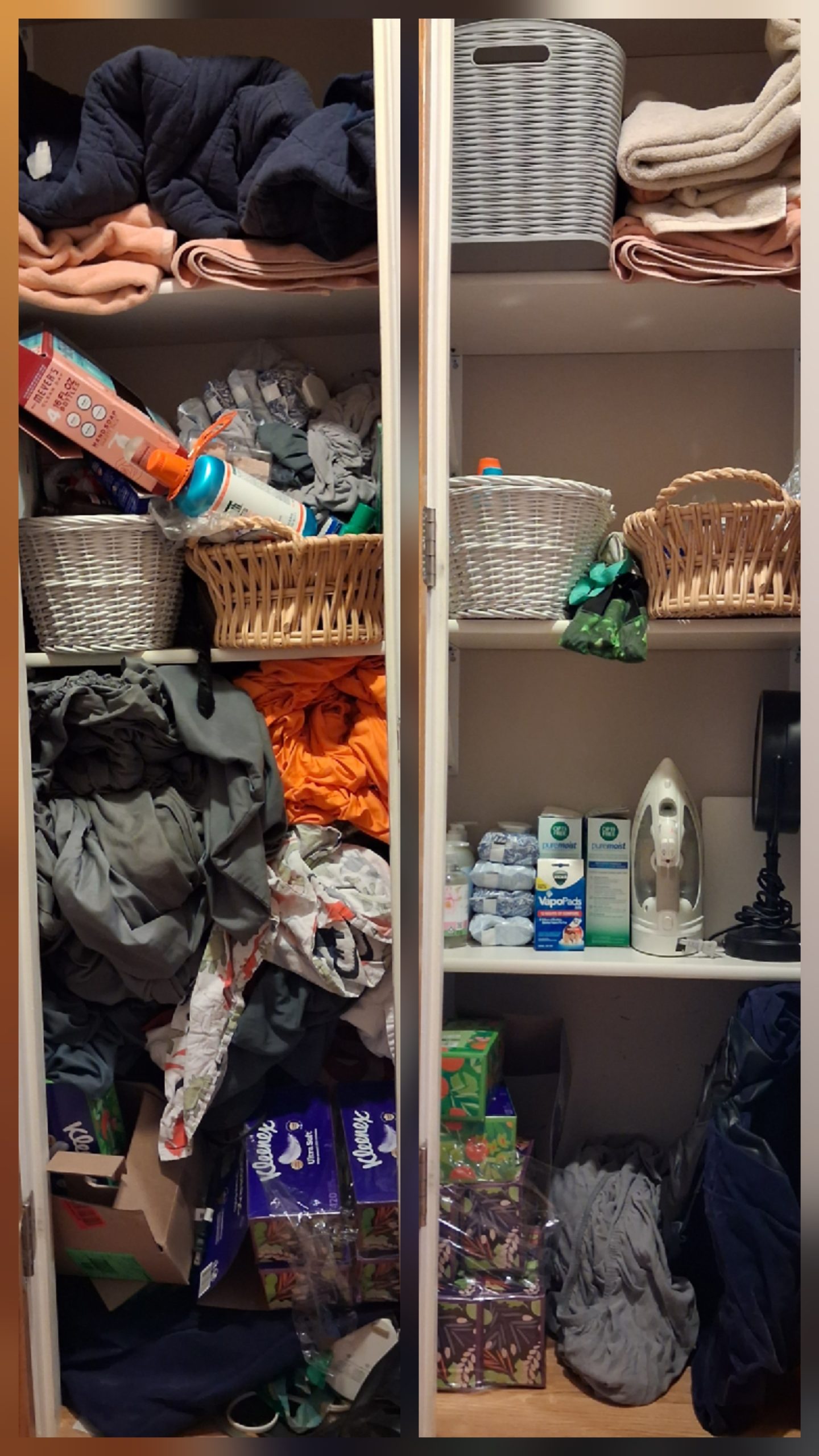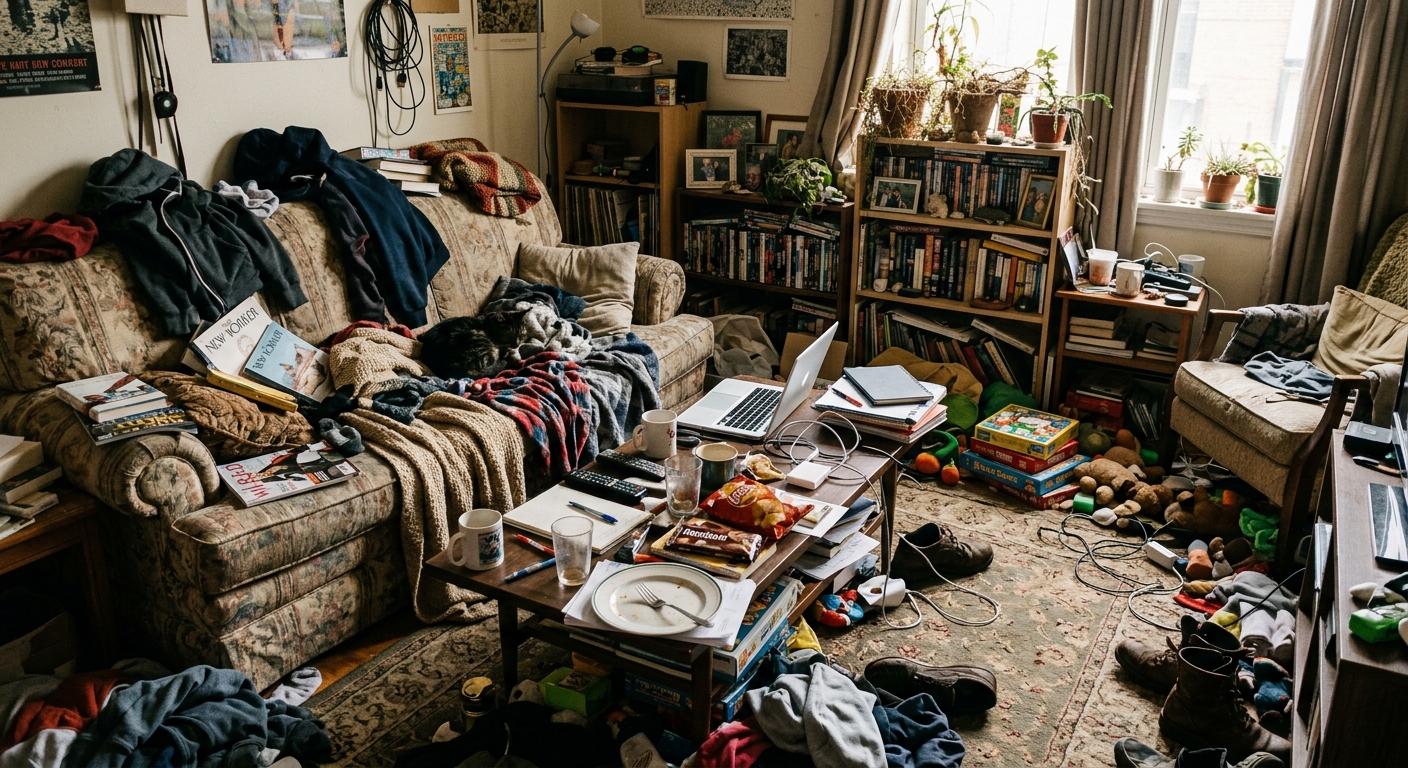
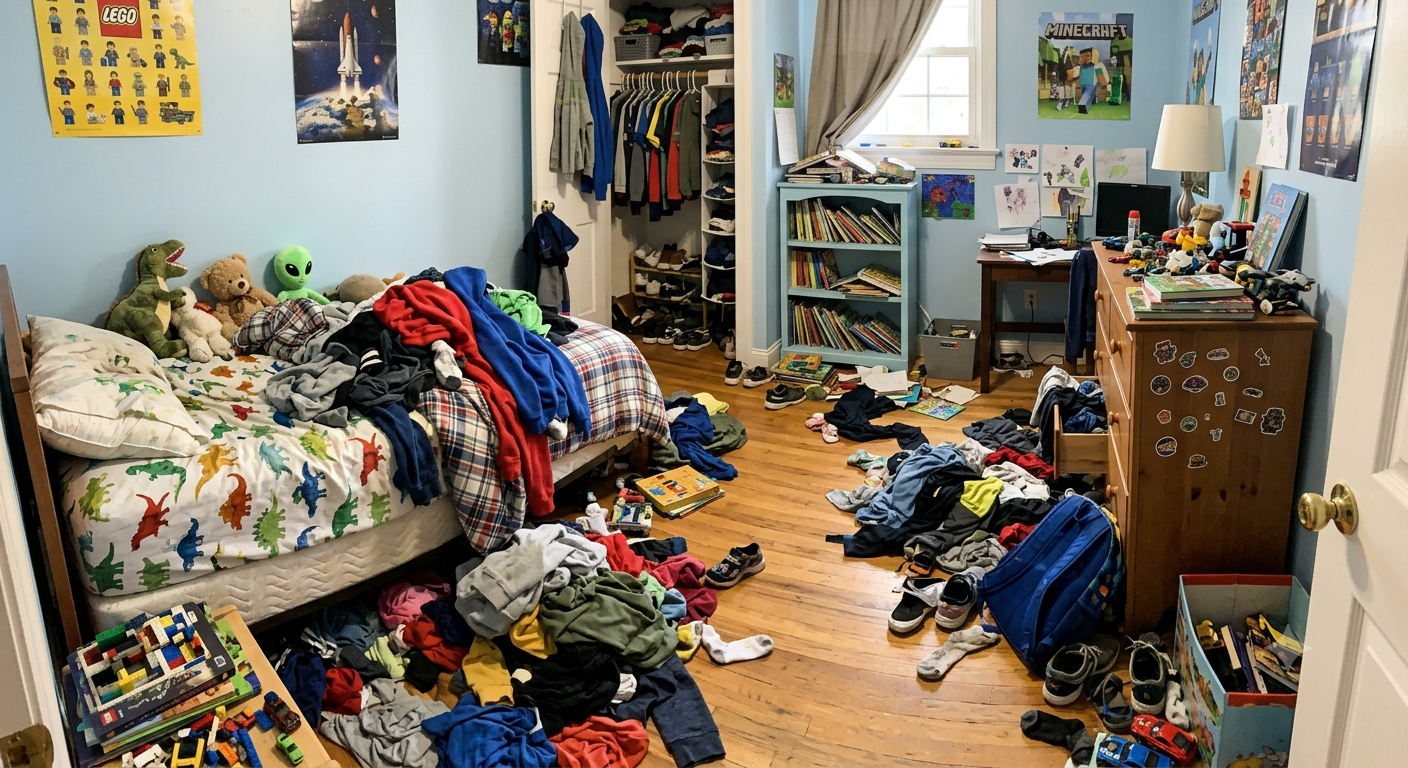
You walk into your teen’s room and it looks like a tornado has hit it. Especially the clothes. There are clothes on the bed, piles on the floor, heaps in the closet. Maybe some have made it into the laundry basket, maybe not. Almost none have made it into the drawers. You sigh, and start to move the clothes on the floor to the hamper and a head pops in the door. “Mom, those are my clean clothes! Now they are mixed in with my dirty clothes!” You have no idea how they can tell, and their room gives you hives. So you back out slowly and close the door so at least you can’t see the mess. You know you taught them how to fold and put away laundry. So what happened?
Organizing styles
What I know now, I wish I would have learned when my kids were much younger. It would have saved us a lot of arguments, rolled eyes, and stress. Cass Aarssen, the Canadian organization expert behind the Clutterbug website and youtube channel, explains four different styles of organization. They break down into whether you like to see everything you own or whether you would rather hide it away and whether you like to group things into large categories or micromanage the stuffing out of them.
Most kids need to see their things to remember they are there. Most also manage large categories much better than extremely detailed systems. So when your son says he has no summer t-shirts, and you know he has 43, it is probably because they are buried under a pile somewhere and he hasn’t seen them in a week (or even an hour, it doesn’t really matter for visual people). And if your kid never puts her hairbows in the size coded, rainbow order, completely adorable drawer caddy that you bought for her, it is probably just too detailed to manage.
Easier is better, even when it’s not “best”
Very few people truly love to do what the rest of us call chores for a reason. So when organizing, one principle is that a thing has to be just as easy to put away “properly” as it is to not put it away. For some people who love a certain style of organizing and whose brains crave a certain sense of order, folding every t-shirt Konmari style and standing them on end in a color organized drawer gives them a hit of dopamine. For many others, including lots of kids, speed is king. Let me finish my laundry so I can go do something more fun! So how do we create a system that works for this need for speed that still serves the function that we want?
The experiment
My middle son (yes, the one I fought with about messy clothes his whole life) came home from college this summer and moved into the basement. He has one of the strongest work ethics I have ever seen, gets excellent grades in college, shows crazy discipline about things he cares about, and already owns his own business. But his clothes have always been everywhere in his living space except put away (or at least a traditional definition of “put away”). Because he now uses a common space as his bedroom, I asked him if I could apply some of the things I have been learning over the last few years to try and create a system that would help keep his clothes neater, while also saving him time. As a kid who is always busy with work, gym, friends, school, and his bike, he agreed to at least give it a shot.
Ditch the dresser
Following the principle of organizing having to follow the path of least resistance, we did away with any sort of dresser. Instead, we opted for 12×12 cubes. Since this was an experiment, we just got them from a dollar store. Although it might end up costing slightly more in the long run if we eventually upgrade, this is a great way to test out an organizational system for little cost before investing in pricey containers. And you might find that they are good enough, and you have saved yourself a lot of money.
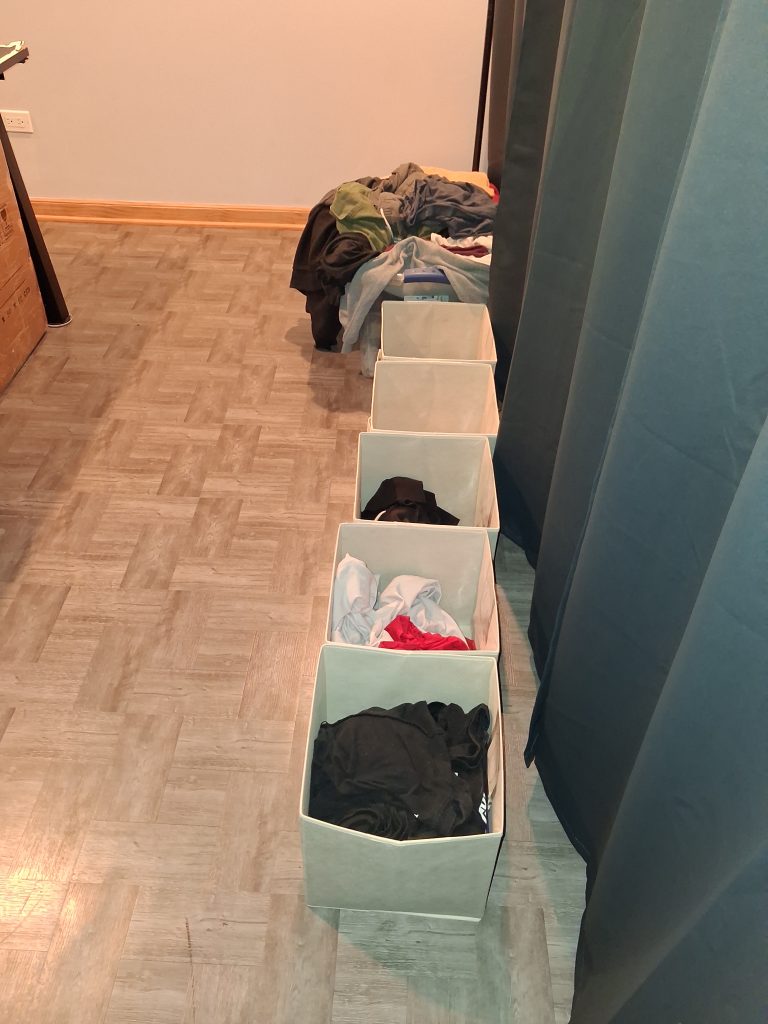
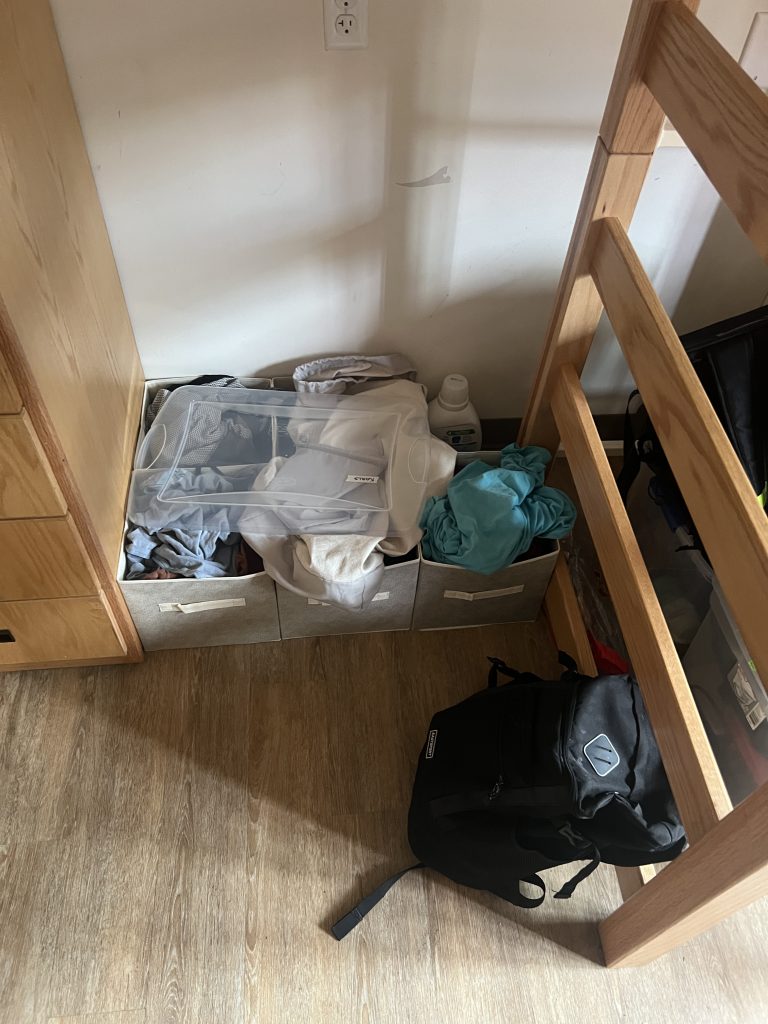
These cubes are sitting on the floor. The clothes were landing on the floor anyway. This at least keeps them clean. To a person who prefers hidden organization, this might not be the most attractive option, but living together always requires compromises. Clothes in a bin look infinitely better than clothes in piles on the floor. But more importantly, this system serves true needs, not just aesthetic preferences.
Labels, labels, labels
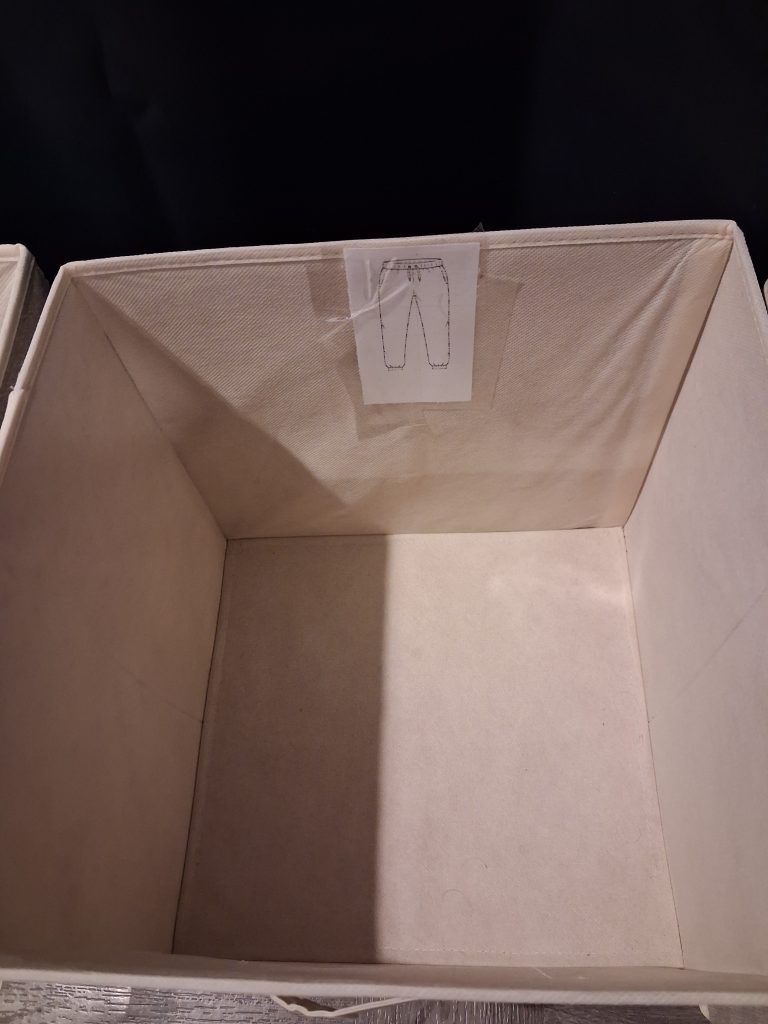
Each cube is labelled with a large category of clothes. Working in conjunction with my son, we decided that just 5 would be enough. He chose bins for long-sleeve shirts, short-sleeve shirts, long pants, shorts, and a bin for underwear and socks combined. He does not own a large wardrobe, so this comfortably handles all of his casual clothes, which as a student is 95% of what he wears. We chose picture labels instead of word labels. This hack comes from studies about neurodivergence and ADHD brains where research shows significant decrease in central executive working memory. This is the part of the brain that does things like store information about color and shape or control focus and attention switching. Even for neurotypical people, this type of picture labelling just frees up brain space for other activities and reduces cognitive load.
Here’s a bonus tip:
Hate matching and rolling socks? Don’t! Buy just one (or maybe two if you need dress socks) style of socks, all in the same color. My boys like high ankle socks in black. Every one of their socks is the same so no matching necessary. They all get thrown in the bin when clean, and getting dressed is as simple as grabbing two socks. Period.
Now, when he does his laundry, the clothes come from the dryer and immediately get sorted into the appropriate bin. Casual clothes in modern fabrics stay remarkably unwrinkled when you don’t cram them into tight spaces. No folding, minimal fuss, and his laundry basket stands ready to hold more dirty clothes. Put the laundry basket near where kids undress and dirty clothes end up in the basket more consistently. When the laundry basket fills to capacity, this serves as the trigger that reminds him that the laundry needs doing.
The benefits
Clothes (should) never end up on the floor any more. Mountains of laundry (should) never pile up. This system keeps things neater than the floor but also cleaner and makes laundry day more manageable because it is a smaller task. The system reduces the amount of time spent putting away laundry, and also the amount of time looking for clothes when getting dressed. The labels also mean that in a pinch, others can lend a hand because the system speaks for itself. Not everyone will prefer this system, but it works for a certain type of brain, personality, and lifestyle. Function in real-life organization trumps form every time.
Tweaking the system
Don’t expect your system to work perfectly from the get-go. First, a learning curve exists. Habits need to be formed. Triggers need to be implemented. If someone else removes his laundry from the dryer, it removes the trigger for my son to put away his clothes. He often won’t notice that the full laundry basket sits there waiting to be sorted. His brain has better things to do than notice that basket. Learning what triggers behaviors in your family members (in the good “this prompts me to remember to do something” way, not the bad “you’re pushing my buttons” way) makes systems work better. Pay attention to when the system works and when it doesn’t. Brainstorm how to make sure the good trigger always happens, or a bad trigger, like nagging, will certainly take its place.
Outline every step
Second, when a part of the system doesn’t work, it might be that it didn’t include enough steps. I know this goes against what I said about fast and easy, but this is more about process than complication. After first setting up the bins with all the labels, I patiently waited for several days while the clean clothes on the floor sat there, and sat there, and sat there. A quick conversation discovered that because we hadn’t thought through to the end of the process, we hadn’t set up a system for where the dirty laundry would go. Don’t assume that unspoken steps are obvious to everyone. Because there was a part missing in the process, it made it hard to even start the process. You might run into this, too. Asking questions about why a system isn’t working might result in some interesting insights that lead to solutions that have nothing to do with laziness or lack of capability. This especially holds true for neurodiverse family members, but really applies to everyone.
Make exceptions
Finally, there are always exceptions to the rule. We had to figure out a system for dress clothes. Hanging things up doesn’t happen as a matter of routine. However, because he wears the dress clothes so seldom, he can keep up with that amount of hanging. A duffel bag still exists of clothes he seldom wears except when he runs out of laundry. In general, donate those clothes as they don’t actually get worn. But if your child must hang on to them, just keep them in one container to give them a limit.
Be flexible
Sometimes systems need to change over time, too, or depending on circumstances. When my son goes back to school, he will tweak the system. The laundry room there is much less convenient to access than at home. Having bigger loads of laundry actually works to his advantage there because the multiple machines in a dorm room laundry mean doing two loads at once actually saves him time. The best systems can adjust for changing needs. This system survived the transition to his dorm room when he went back to school.
Make your space (or system) work for you
As a former teacher I excelled at using differentiated instruction for the many types of learners in the classroom. Realizing that the same concept applies to organization styles and home systems was a game-changer for me. If you need help thinking outside the box for different personalities in your family, give me a call today!